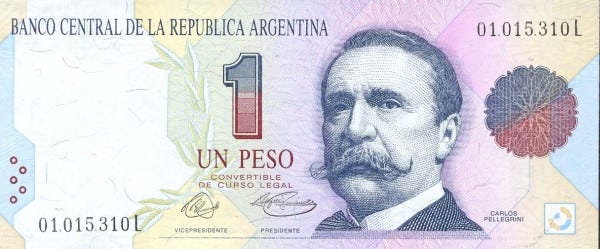
For two centuries, investing in South America has become synonymous with losses, or at least excessive risk. Argentina has been no exception, with nine defaults since its independence in 1816.
With such a horrendous track record, why on earth did the United States conduct a multibillion-dollar bailout of Argentina and how on earth did the U.S. manage to make money on the deal?
The why is fairly simple and straightforward, with just two components.
First, Javier Milei is regarded as a friend to the current Trump administration and a strategic partner. Supporting the Argentinian government fulfills both financial and nonfinancial interests in the Western Hemisphere.
Whether that’s true or not isn’t the point—we’re just laying out the thinking here of the White House. Milei is considered to have “Trumpian” qualities, especially the ways in which the former has been cutting down the size of government and going after more left-wing causes in his country.

The second “why” behind the Argentina bailout is that it wasn’t really a bailout, at least not in the traditional sense. In truth, it was a way for the Treasury to make easy money.
Yes, you read that right. And this is where things get really interesting.
It was clear that international investors were beating down the Argentine peso because of the country’s terrible financial position. For years, Argentina has been bouncing between inflation and hyperinflation as the central bank prints money to cover never-ending budget deficits.
That’s how you get annual inflation rates in the hundreds of percentage points. Imagine the worst annual inflation in the U.S. during 2022 was happening in a matter of days instead of a year—that’s what Milei has been trying to fix.
So, far he’s done a decent job, getting inflation down by a whopping 90% to just one-tenth of what it used to be. The government also recently posted its first budget surplus since 2009.
Ironically, the strengthening of the government’s previously precarious financial position was what set off this miniature crisis.
Let’s just consider our own situation in the U.S. to explain why the government sobering up could be so disastrous.
Imagine if the Federal Reserve suddenly called it quits on covering government shortfalls and bailing out bad financial actors. No more inflation, just liquidation.
Instead of papering over losses with paper money, the Fed would allow those losses to be realized, whether by consumers, banks, businesses, investors, or Uncle Sam.
Worse, the current federal deficit would cause Treasury yields to skyrocket without the Fed as debt purchaser of last resort. Congress remains so out of control with its spending that October’s deficit was the worst start ever to a fiscal year—even worse than the blowout spending in 2020.
Besides Treasury market chaos, banks would start collapsing left and right without an entity to buy all their junk securities packaged as “investments” and to cover the over 90% of deposits that aren’t covered by cash.
Americans would see 401(k)’s plummet, along with home prices.
Then gold and silver would hit levels previously unimaginable, not because of dollar devaluation but a flight to safety.
In short, the whole facade comes crashing down. The managed destruction of the dollar via inflation is the glue keeping this fragile system of ours together.
The financialization of everything and the perpetual bailout systems the Fed has built are the monetary equivalent of a series of codependent relationships between 100 different people—and just as destructive.
If you want to stop the inflation here at home, you’d need to first slam on the brakes of all the things that require the inflation. For starters, that means massive cuts to government spending.
Ironically, Argentina was following this formula, yet still nearly fell into the abyss. Milei was cutting whole departments and firing bureaucrats everywhere while slashing the budget. How’d the situation spiral out of control?
Because investors got overly optimistic. They stopped abandoning the Argentine peso. Some even piled in. The peso’s freefall became a managed decline, then an erratic decline.
The currency was still losing value, but not fast enough. Remember, inflation has been the glue holding the fraud together. Without enough of it, things start falling apart.
Since the peso wasn’t falling fast enough, many trades began unraveling, just like we’ve seen with the Yen-carry trade recently. International trade was also affected, as were sovereign debt markets.
It also imperiled Argentina’s ability to repay loans as the peso became more than 50 percent overvalued. Instead of paying back cheaper money, Milei was doing the opposite.
Well, not quite the opposite—the currency was being devalued, but not nearly as fast as previously estimated. That meant the money going out the door was worth more than they thought it’d be worth.
Without the central bank rolling out tons of new pesos, Milei was finding himself short and in desperate need of a cash infusion, especially if his government was going to continue repaying international loans on time.
What he needed was either a lot of pesos or a lesser quantity of another currency that people wanted more.
Enter Treasury Secretary Scott Bessent, the Sultan of Swap.

Here’s the quick and dirty version of the agreement between Argentina and the Treasury:
The Treasury would use its special drawing rights at the international monetary fund to dump cash into the exchange stabilization fund, with the latter financing a currency swap so that Argentina could use dollars while it’s short on pesos.
The swap is similar to something else our readers have seen time and again: repurchase agreements.
Currency is exchanged not once but twice. So, Argentina first hands the Treasury a pile of pesos and gets a sack of dollars, at a specific exchange rate. Then, at a previously agreed-upon date, the swap matures and the exchange is reversed.
In normal times, when currency markets are functioning properly and currencies are relatively stable, there’s no reason to do such an exchange and there’s certainly no arbitrage.
But these aren’t normal times—not by a longshot. And Bessent knew it.
What he recognized was that markets were out of balance, and he could take advantage of the opportunity. A very crude parallel would be a put option or call option.
Of course, the nature of a swap means the change in relative currency values is not where the money is. Although you do guarantee a future exchange rate, it’s the same as the original.
The real arbitrage lies in the ability to utilize one currency over another when there is a temporary increase in demand for one currency over another.
In exchange for this temporary use of dollars, the Treasury is getting interest and fees.
Amazingly, Bessent is probably the first person in history to make money buying Argentine pesos. When we say he’s the master of sovereign debt markets, we mean it.
After all, this is the guy who broke the Bank of England, the world’s oldest central bank, in 1992—not even one month after his 30th birthday.
In short, Bessent knew which way the peso was going to go relative to the dollar because he constantly has his finger on the pulse of currencies and which currencies are being over/undervalued by markets.
That knowledge allowed him to make a deal that gave the Treasury the right to exchange currencies at a value that may not necessarily have made sense at the time to the rest of the market but would in the future.
As usual, Bessent was right.
This is why the Treasury has made money on the deal, contrary to Bessent’s initial critics who have once again been proven wrong.
Flush with dollars to settle accounts, Argentina almost instantly calmed investors, traders, and other market participants.
Does all this mean Argentina is in the clear? Far from it.
A good parallel is the current cost-of-living crisis in America. In 2025, inflation-adjusted earnings have grown about 1 percent, but they fell about 4 percent over the previous four years. We’ve made progress this year, but we’re still not “back.”
Likewise, Argentina has made incredible progress in a very short period. Inflation has fallen from several hundred percent annually to about one-tenth of that. Government spending is being slashed with a chainsaw—literally.

But Argentina is still not in great shape, and that’s why it would be unreasonable for that country to have a credit rating of AAA+ or its equivalent depending on the ratings agency.
Argentia is saddled with years of bad debt from years of horrendous budgets created by many terrible “leaders.”
Nevertheless, the country is finally headed in the right direction, and that should be priced in to Argentinian yields too—direction and magnitude sometimes matter more than position.
Bessent understood that markets were beating down Argentina for past mistakes, not current corrective action, and so the pseudo-bailout made sense.
As did extending a further line of credit. This dollar backstop essentially instills so much confidence that it’ll never have to be used. If people thing the peso is as good as dollars (at some specified ratio) then people don’t mind holding peso.
And that’s why, ultimately, Argentina will likely dollarize, a move which could be mutually beneficial for both countries.
First, it allows Argentina to use a more desirable currency on the world stage, giving them much needed flexibility. Second, it provides some much-needed demand for all the dollars Uncle Jerome is about to print when he restarts quantitative easing in the coming weeks or months.
So, don’t cry for Argentina—the country will be fine. Cry instead for us if Congress doesn’t get its act together, and soon.
Our elected representatives put drunken sailors to shame—both in terms of spending and in terms of alcohol consumption—so it’s hard to see how we’ll evade Argentina’s fate in the long run.
Of course, when the world’s biggest economy gets there, who will bail it out?
When the world’s reserve currency needs a lifeline, who conducts the swap?
Food for thought…